Directors Carlos O. Manalastas, Angel Labra Story/Screenplay Jerry O. Tirazona
Cast Trovador Ramos, Rommel Valdez [as Rommell Valdez], Gina Pareno, Paquito Diaz, Charlie Davao, Perry Baltazar, Max Alvarado, Protacio Dee, Johnny Vicar, Ernie Ortega, Robert Rivera, Ruben Ramos, Sancho Tesalona, Jun Santos, Pong Pong, SOS Daredevils, PMP [Stuntmen], PIS [Stuntmen], Tracma Boys, Pepe Cruz, Rey Javier, Jim de Leon
Proposed Cast* Trovador Ramos (Cabigat, an Igorot brave whose father was killed by a band of goons), Rommel Valdez (Rommel, top undercover agent of the law who comes to the small Igorot village to get classified information about landgrabbing in the place), Gina Pareno (Lamya, the Igorot maiden), Charlie Davao (Don Manolo, the greedy landlord and miner), Sancho Tesalona (Sancho, one of the Don's trusted men), Johnny Vicar (Johnny, another trusted man of the Don), Jim Delon (Jim, Rommel's detective partner) Don's Henchmen Aldo Cruz, Rey Javier, Larry Silva, Jimmy Javier, Jimmy Evangelista
KUNG FU
*from the shooting script submitted to the Board of Censors in 1974
THE LOST MOVIE PROJECT: Piecing together the fragments of the Philippines' vanished cinema
NOTE by Andrew Leavold: Yet another Pinoy martial arts film from the initial rush of Bruce Lee-inspired movies. This time Trovador Ramos, head of Filipino-based martial arts organization TRACMA (hence his own stunt team TRACMA Boys) and, so the story goes, the only man to ever beat Bruce Lee in a sparring match, was top-billed along with former stuntman Rommel Valdez. Red Belt Master was entered in the 1974 Manila Film Festival and vanished soon afterwards; other than the newspaper ad, the only evidence we can find of the film is the outline in the shooting script submitted to the Board of Censors in 1974...
SYNOPSIS: Time was during the early part of the 1950s. In the far-flung areas, the rich and the powerful harass and oppress the poor - using their riches and power to amass wealth; and amass more wealth just to maintain their power and stature.
Our story is centered on a group of Igorot tribesfolk somewhere in a sleepy community in the Mountain Province, ruled by their chief, Lakay Bugan.
A group of armed goons harass the tribe, the purpose is to frighten them into leaving their village. The leader of the goons is a rich landed gentry named Don Manolo - who wanted the place of the Igorots vacated so that his secret in a nearby coal mines will not easily be made vulgar. Actually, he is not just mining coal as what he wants the authorities to believe: He is mining diamonds in a secret compartment inside the coal mines caves, a mining operation which he hides so much from the government and the people around so he won't pay large sums of money in taxes plus the fact that the government may take over the mining operations from him.
In trying to frighten the Igorots, Don Manolo's armed goons hang Lakay Bugan from the branch of a tree. With this, he is successful.
Classified information reaches the office of Colonel Ramos who is head of an intelligence group about several cases wherein those who were said to have gone near the Black Mountain were not able to get back and were believed to be either lost or dead. The Colonel right then and there sends his top-calibre undercover agent to the place to conduct an investigation.
It so happens that a certain man called Cabigat also arrived in the area and finds his way in the wooded area until he comes to the newly-settled Igorot tribe who had fled their former settlement. Actually, Cabigat is the only son of the murdered tribal chieftain. He had left his tribe when he was at the age of 12 when he was brought along to Tokyo by a Japanese soldier just after the last World War. In Tokyo he served under a Japanese karate master and had learned the art himself by which he earned the 13th dan red belt championship honor.
The undercover agent - Rommel Valdez - arrives in the vicinity of the Black Mountain, pretending to be hunting for wild pigs. Goons chance upon him. They shoot him, wounding him on the breast, then maul him and left him for dead. Later that evening, some Igorot braves chance upon him and bring him with them to their new settlement where an Igorot maid named Lamya takes care of him to nourish him back to health.
Cabigat and Rommel come to know each other, the tribe being now under the leadership of the former. Cabigat wants to fit force against Don Manolo and his goons but Rommel convinces him about using peaceful means. But this becomes a vain attempt because the town mayor is in cohorts with the Don.
A series of incidents lead one day to the disguise of Cabigat and Rommel as miners and penetrate the mining camp where they are immediately unmasked. They have no other way but to fight to defend themselves. They discover the secret and are able to kill some of the goons and capture the rest. As for Don Manolo, he is brought by Rommel to justice.
1965 – Kaaway Bilang Uno/“Enemy Number One” (Cirio Santiago Film Organization) LAGALAG #4
[Release date 1st March 1965]
Director/Producer Cirio H. Santiago Screenplay Teodorico C. Santos [as T.C. Santos], Ruben Rustia, Manuel Songco Based on the DZRH Radio serial Music Tito Arevalo Layout Artist Eddie Domer
Cast Eddie Fernandez (Lagalag), Paquito Diaz, Gina Alonzo (Laura), Carol Varga, Ruben Rustia, Nello Nayo, Sammy Sarmiento, Tommy Romulo, Fred Param, Fred Memije, Cesar Leyson
ACTION/SPY
NOTES: The fourth in a series of Filipino spy thrillers initiated by director Cirio H. Santiago, starring Eddie Fernandez as Agent Lagalag, and Gina Alonzo as Laura, his Girl Friday. The entire series is currently believed to be lost.
[Release date 25th December 1976; released internationally by Fems Films Production (HK) Ltd as “The Interceptors vs The Bionic Being”]
Director Efron C. Pinon Screenplay Jerry O. Tirazona Producer Jun Dominguez Cinematography Benjamin Lobo Music Tito Sotto Layout Artist Eddie Domer
Cast Tony Ferrer* (Tony Falcon, Agent X-44), Ramon Zamora* (Dragon), George Estregan* (Bimbo), Edna Diaz* (Menchu Sylvestre), Paquito Diaz** (Syndicate Member), Charlie Davao** (Sanchez, the Bionic Being), Vic Diaz** (Syndicate Member), Max Alvarado** (Boy), Arnold Gamboa**, Val Iglesias** [as Val Iglesia] (Carlo), Brenda del Rio** (Christie), Tsing Tong Tsai**, Golay**, Jess Ramos** (Colonel Villiar), [not listed in credits or on poster] Baldo Marro (Agent), Robert Talby (Syndicate Goon), Eddie Nicart (Goon in Alleyway), Lauro Flores (Syndicate Goon), Romy Nario (Goon at Plant)
SPY/KUNG FU/SCIENCE FICTION
*Names listed in credits and on poster
**Names listed on poster only
Review by Andrew Leavold (coming soon)
Tony Ferrer (Tony Falcon, Agent X-44)
Ramon Zamora (Dragon)
George Estregan (Bimbo)
Edna Diaz (Menchu Sylvestre)
Paquito Diaz (Syndicate Member)
Charlie Davao (Sanchez, the Bionic Being)
Vic Diaz [left] (Syndicate Member)
Max Alvarado (Boy)
Arnold Gamboa
Val Iglesias [as Val Iglesia] (Carlo)
Brenda del Rio (Christie)
Tsing Tong Tsai
Golay
Jess Ramos [left] (Colonel Villiar)
Baldo Marro (Agent)
Robert Talby [right] (Syndicate Goon)
Eddie Nicart (Goon in Alleyway)
Lauro Flores (Syndicate Goon)
Romy Nario [right] (Goon at Plant)
THEATRICAL
Image courtesy of the Video 48 blog
PHILIPPINES - 25th December 1976, during the ......... Film Festival
JAMAICA - as "The Interceptors vs The Bionic Being", release date unknown
VIDEO
LEBANON - as "The Interceptors vs The Bionic Being" [subtitled in Arab and French, and evidently taken from a theatrical print]
- mp4 file [dubbed into English, with Arab and French subtitles]
Director Augusto Buenaventura Story/Screenplay Nestor St Roy [poster lists "Writer" as Augusto Buenaventura] Producer [uncredited] Joseph Estrada Executive Producer Emilio Ejercito Assistant Executive Producer Jesus M. Ejercito Cinematography Fredy Conde Music Restie Umali Editor Atilano Salvador Sound Manuel C. Daves Production Coordinator A.C. Montesines Production Manager Raul Aranda Assistant Director Simplicio Pajarillo Makeup Artist Baby Maclang Field Soundman Godofredo de Leon Assistant Cameraman Manuel C. Roxas Jr Schedule Master Roger Bonagua Assistant Editors Rogelio Salvador, Edgardo "Boy" Vinarao Laboratory Antonio Camato, Ananias Latagan Printers Zeny Ambos, Nelfa Arce Titles "MRL" Stills Francisco Salanga
Cast Joseph Estrada (Joe Soliman), Jess Lapid [Sr] (Jessie Soliman), Jun Aristorenas (Johnny Soliman), Paquito Diaz (Bernie), Imelda Ilanan, Gina Laforteza (Gina), Rebecca (Elisa), Renato Robles, Larry Silva, Avel Morado, Ben Dato, Max Alvarado (Rosco), Romy Diaz (Iscarella), Angel Confiado, Ben Bernal, Bobby Gianzon, Rudy Samoy, SOS Daredevils, Ike Fernando, Jose Padilla Jr (Diego Soliman), Anita Linda (Carmen)
ACTION
NOTES: Executive Producer Emilio Ejercito is Joseph Estrada's father, while his assistant Jesus M. Ejercito is Joseph's youngest brother
Mini-review by Andrew Leavold
Equal parts romance, comedy, fisticuffs, back-alley knifings and family melodrama as the Soliman boys - Sixties action icons Joseph Estrada, Jess Lapid Sr and Jun Aristorenas - defend their poor Manila neighbourhood from the Syndicate, while released felon Bernie (Paquito Diaz) reignite their father's (Jose Padilla Jr) criminal ties. Brother Joe (Estrada) is primarily concerned with maintaining the family's dignity in its poverty; his siblings are more interested in climbing the social ladder - the hotheaded but terminally shy Jesse (Lapid, playing against his usual confident type) trying to impress the boss' daughter (Rebecca), gigolo Johnny (Aristorenas) strutting around rich girl Gina (Laforteza), whose father, another past associate of Bernie, is being blackmailed by henchman Iscarella (a young, clean-cut Romy Diaz). Anita Linda is fantastic as Carmen, fallen woman and consort of Soliman Sr, as well as mama-san at Carmen's Place where Joe's girlfriend (Imelda Ilanan) works and observes the unfolding tragedy, and Max Alvarado, Larry Silva and the SOS Daredevils help with the regulation goons. Soliman Brothers' slum dramatics are underscored by Restie Umali's terrific, frenetic jazz, surf and pop numbers, strictly by the numbers and, as formulaic Sixties goon actioners go, impressively so.
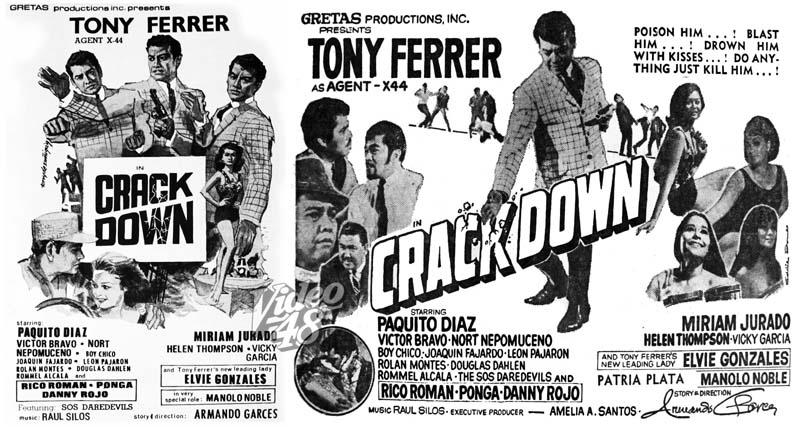
[Release date 17th May 1967; sometimes listed as “Crack Down”]
Director/Story Armando Garces Executive Producer Amelia A. Santos Associate Producers Jose “JRS” Magno, Peping Ortega Cinematography Ricardo M. David Music Raul Silos Singer Helen Thompson Editor Teofilo de Leon Sound Supervisor Luis S. Reyes In-Charge Of Production Ricardo E. Gonzales Production Manager Ben Fortuna Assistant Production Manager Itchie Mercado Art Director Nasario M. Marquez Assistant Director Roger Vivero Special Effects Totoy N. Torrente Makeup Artist Generosa Garcia Setting Director Ariston de la Paz PropsMan Francisco de la Paz Cameraman Ding Austria Field Soundmen Felicismo Hidalgo, Ernesto Goltiano Schedule Master Ben Dayao Assistant Editor Benigno de Leon Stills Ben Corachea Titles “D’Antonio” Layout Artist [uncredited] Eddie Domer
Cast Tony Ferrer (Tony Falcon, Agent X-44), Paquito Diaz, Victor Bravo, Nort Nepomuceno, Miriam Jurado, Helen Thompson, Vicky Garcia, Elvie Gonzales, Boy Chico, Joaquin Fajardo, Leon Pajaron, Rolan Montes, Douglas Dahlen, Rommel Alcala, Doming Viray, Vergel Santos, Ely Ventus, Napoleon Tort, Polly Azarcon, Freddie Guinto, Buddy Salvador, Chit Lopez, Eddie Gracia, Eddie Cabal, SOS Daredevils, Manolo Noble, Patria Plata, Rico Roman, Ponga, Danny Rojo
SPY/ACTION
NOTE: This is the sixteenth in a long-running series of Agent X-44 films starring Tony Ferrer. For a full filmography and detailed article on the X-44 series, click HERE.
Review by Andrew Leavold (coming soon!)
UNDER CONSTRUCTION
THEATRICAL
- mp4 file [b&w, in Tagalog with no subtitles] (sorry, not for sale, so please don't ask)
1965 – Contra Señas/“Counter Signal” or "Counter Sign" (Tagalog Ilang-Ilang Productions)
[Release date 12th September 1965]
Director Eddie Garcia Story/Screenplay Henry Cuino Producer Attorney Espiridion Laxa Cinematography Fortunato B. Bernardo Music Carding Cruz Editor Gervacio Santos Sound Supervisor Flaviano Villareal Sound Effects Marcelo Solo Production Manager Jose D. Laxa Assistant Production Manager Ramon Navarro Assistant Director Tony Dantes Special Effects Jaime Trajano Jr? Makeup Artist Cely Vega Settingmen Absalon Eslaban, Ben Gozo Propsman Edgardo Manlap Layout Artist Marvin B. Panganiban
Cast Tony Ferrer (Tony Falcon, Agent X-44), Barbara Perez (Vivian Gera), Miriam Jurado (Margie), Rod Navarro (Galvan's Henchman), Paquito Diaz (Galvan's Henchman), Arnold Mendoza, Bessie Barredo, Victor Bravo, Manolo Robles, Jose Garcia [as Joe Garcia] (Professor Gera), Manolo Noble (Colonel Campos), Rocco Montalban (Galvan's Henchman), Jennings Sturgeon (Alfred Kohnor), Menchu Morelli, Danny Rojo, Leon Pajaron, Rudy Dominguez, Greg Lansang, Rey Lapena, Rudy Moreno, Arsenio Almonte, Hernando Costa, Max Alvarado (Assassin), Nello Nayo, Sammy Sarmiento, Oscar Keesee [Jr] (Senor Galvan)
SPY/ACTION
NOTE: This is the fourth in a long-running series of Agent X-44 films starring Tony Ferrer. For a full filmography and detailed article on the X-44 series, click HERE.
Extract from Andrew Leavold's “Ang Artista At Ang Falcon”
journal article on Eddie Garcia directing Tony Ferrer’s Agent X-44
films, Pelikula Magazine Volume 5, published by the University of the
Philippines, December 2020
In the early- to mid-Sixties there were two major trends in the Philippines’ cinema – independent outfits taking the place of the crumbling studio system previously dominated by Sampaguita, LVN and Premiere, and action films. Rough, fight-laden, populated with “goons” (the stuntmen-turned-bit players used as human punching bags for the bidas or heroes). In addition to war films, westerns and urban crime films, and their inevitable parodies by Dolphy and Chiquito, a new trend sweeping the world: Bondmania. By the time the third James Bond adventure Goldfinger was released in early 1964, almost every filming country had their own homegrown spy hero battling one nefarious organization or another bent on world domination. The Philippines, always with an opportunistic eye on popular trends, took to the spy craze like a starving man handed a balut, and between 1964 and 1967 more than a hundred Filipino Bond imitations were released, as each action star sought to sex up his image, and each hungry independent producer wanted a slice of the action.
One of the hungriest was Tagalog Ilang-Ilang Productions run by Pampanga-born producer and president Attorney Espiridion Laxa, specializing in war, western and action films starring hot new stars such as Fernando Poe Jr and Joseph Estrada. “He would gamble on new ideas,” Eddie said about Laxa. “Tagalog Ilang-Ilang Productions was one of the most successful producers during that era.” Many of TIIP’s films starred Laxa’s younger brother Antonio, rechristened Tony Ferrer (after Hollywood actor Jose Ferrer), in a supporting role to Poe Jr, Estrada, Jess Lapid and others. Unfortunately for Tony he never really made much of an impact on audiences.
That was, until he became Tony Falcon, Agent X-44.
Falcon was the Laxa’s answer to Lagalag and Anthony Alonzo’s Agent 69 (1964), and in January 1965 the first X-44 adventure, G-2/Taga-Usig Ng Kaaway (“The Enemy Interrogator”), was released by independent outfit Broadway Pictures (no doubt associated with or even bankrolled by Laxa’s TIIP). Eddie Garcia was drafted as director; for him it was the first of these new Bond imitations. The film has long since disappeared but evidently a hit with audiences and firmly established the new character of G-2 operative Tony Falcon, Agent X-44, pairing him with the already-established Agent 69, which Tagalog Ilang-Ilang also did with the second X-44 film Kalaban Ng Sindikato, also directed by Eddie, only two months later. Interpol was the third, followed by a fourth –the earliest X-44 adventure AND Eddie Garcia-directed film in existence – called Contra Señas, or “Counter Signal”.
At immediate glance Contra Señas is a quantum leap forward in quality from the first three films. It is the first X-44 film in color, which was considered a big deal at the time, and usually reserved for the studios’ roadshow presentations. Cast opposite Ferrer is Barbara Perez, known at the time as the “Audrey Hepburn of the Philippines”, and was hot property, especially after she was offered a Hollywood contract in the wake of her appearance in the US production No Man Is An Island (1962). Then there’s the film’s opening, a magnificently staged sequence of shots in which Tony Falcon is dwarfed by massive oil tanks as he prowls and karate-chops his way through a goon-infested refinery (specifically the Shell Refinery in Batangas), while the music – Carding Cruz and his orchestra’s bongos, shimmying horns and staccato jazz stabs - propels the action along. Falcon then sets the refinery (more specifically, its miniature!) to explode, capping off an impressive credit backdrop which, although admittedly not up to Hollywood standards, is comparable to any Italian or Spanish Bond knock-off.
Contra Señas immediately kicks in with Professor Gera (Jose Garcia) offering his anti-missile formula to both the Philippine government and a shadowy organization (Red China? Russia? Intriguingly it’s never mentioned by name) for 200 million pesos. To ensure his personal safety Gera deliberately withholds the missing part of the formula, the “counter signal” of the film’s title, but is still kidnapped by the global conspiracy’s Manila representative Senor Galvan (Gerry de Leon and Eddie Romero regular Oscar Keesee Jr) and his parade of henchmen (Paquito Diaz, Rod Navarro, Victor Bravo), each one with a small army of apes in suits (Rocco Montalban etc), who threaten to snatch Gera’s only daughter Vivian (Barbara Perez). G-2 boss Colonel Campos (Manolo Noble) assigns his top agent Tony Falcon to protect Vivian; little does Tony know that Vivian’s rich socialite friend Margie (Miriam Jurado) is not only a member of Galvan’s nefarious organization, but is – horror of horrors – trying to destroy the budding romance between Vivian and Tony. The counter signal is finally revealed to be inscribed on a wheel-shaped pendant around Vivian’s shapely neck, but it’s too late, as the seemingly doomed lovers are grabbed and X-44 finds himself strapped to a table with a huge metal arrowhead aimed at his particulars.
Very much a product of its time and its formula, Contra Señas does little to deviate story-wise from the hundred other Pinoy Bonds. What is does impart is a level of worldliness not usually seen in Filipino action films of the period, as well as a high degree of sophistication in the way the story is translated onto the screen. “I enjoyed doing these Falcon series,” Eddie admitted in a 1978 interview in Expressweek. “They gave me the chance to explore the camera through quick pacing, fancy camera angling, all that stuff… I like my work to be fluid in the use of visuals and in continuity. I do a lot of homework even before the actual filming starts, and the script is usually pre-edited before the shooting begins.” Presumably Eddie was given more time and a larger budget than a regular Tagalog action film, and Eddie’s professionalism shows in his dynamic composition (high angles, triangular shots) and fluid action, in stark contrast to the usual technique of filming actors talking in a line in continuous shots.
Take, for example, the extended fight scene between Tony Ferrer and Paquito Diaz. Paquito’s character Maurice lures Tony Falcon to a deserted warehouse and ambushes him, initiating an unnaturally drawn-out and brutal fist fight. Eddie films much of the action from the warehouse’s mezzanine level, using low lighting to cast unnaturally long shadows. It’s beautifully staged and shot, using minimal cuts –clearly not for budgetary reasons, but instead to punctuate the violence. At one point Tony Ferrer can be seen falling down the warehouse’s stairs, then gets up and continues to punch the living hell out of Paquito Diaz – all in one single shot.
Many of the film’s pleasures lie in watching the actors trade on their familiar screen personalities. Quintessential villain Max Alvarado, one of the most frequently used goons in the entire X-44 series, makes a brief appearance in Contra Señas which he is used with maximum effect as both muscle and comic relief: playing hitman Damazol hired by Margie to kidnap Vivian and Tony Falcon, Max arrives at Vivian’s door in a ludicrous wig posing as her wildly effeminate manicurist. Damazol then Garottes one of Falcon’s sentries before Falcon literally stops him dead with a series of karate chops to the face. Another ubiquitous face in the early Tony Falcon films is “white goon” Jennings Sturgeon, a former GI who stayed in the Philippines after World War 2 to raise a family and study art at UP Dilliman. His in-law, screen villain Johnny Monteiro, introduced him to the movies, his gaunt features and an unfeasibly thin frame often gracing Eddie Romero war pictures; in Contra Señas he adds an eyepatch and a reasonably convincing accent to his East German agent character Alfred Kohner, a torture specialist imported from behind the Iron Curtain to extract the whereabouts of Professor Gera’s counter signal. Unfortunately for the shadowy cabal Gera chokes on Kohner’s cyanide-laced cigar before he can talk, leaving Kohner to berate himself for being too efficient. Sadly, Contra Señas would prove to be Sturgeon’s final film appearance before taking his own life.
Part of the success of Contra Señas is its repertory company, under the guidance of Tagalog Ilang-Ilang’s Attorney Espiridion Laxa. In addition to Eddie Garcia as director, there are writer Henry Cuino, Carding Cruz and his orchestra, the recurring characters Tony Ferrer and Manolo Noble, returning actors Victor Bravo, Rod Navarro, Paquito Diaz, and those supporting actors and bit players (the “goons” of Filipino cinema like Alvarado, Rocco Montalban). Through the craggy features and rugged landscape of Goon Cinema, the peculiarly action-centric films of the Philippines, these Bond imitations become recognizable in itself: characters, faces, musical motifs, rhythms, authorial stamps, all are part of the iconography of Philippine pulp cinema, of which Contra Señas is a well-crafted example. Disposable? Probably. An important time capsule of the Filipino audience’s desires and expectations? I would argue: most definitely. The innate worth of these films comes down to your own prejudices. If you’re expecting National Cinema or indigenous storytelling, you’re in for a rude shock. The X-44 films exist in an entirely different universe, far removed from the social realism coveted by serious cinephiles - a world of leisure suits, fancy mansions, sports cars; an imitation of the spy world portrayed in the West, and thus pure wish fulfillment as well as totally escapist fare. But as globalist as the films may be, they do have a local flavor. Bond Adobo (or Adobond?): a uniquely Filipino hybrid of a very recognizable original.
Tony Ferrer (Tony Falcon, Agent X-44)
Barbara Perez (Vivian Gera)
Miriam Jurado (Margie)
Rod Navarro (Galvan's Henchman)
Paquito Diaz (Galvan's Henchman)
Arnold Mendoza
Bessie Barredo
Victor Bravo
Manolo Robles
Jose Garcia [as Joe Garcia] (Professor Gera)
Manolo Noble (Colonel Campos)
Rocco Montalban (left - Galvan's Henchman)
Jennings Sturgeon (Alfred Kohnor)
Menchu Morelli
Danny Rojo
Leon Pajaron
Max Alvarado (Assassin)
Nello Nayo (right)
Sammy Sarmiento
Oscar Keesee [Jr] (left - Senor Galvan)
THEATRICAL
PHILIPPINES - 12th September 1965
GUAM - week starting 3rd November 1974 at the Dededo theatre ["English Version" as Counter Signal]
HAWAII - still playing the American and Haleiwa theatres as late as 1976 ["English Version"]
USA - week starting 7th December 1979 at the Grand Theatre, San Francisco, in a double bill with Burlesk Queen
- mp4 file [dubbed into English] (sorry, it's not for sale)

.jpg)




%20Title%20card%203.png)

%20Barbara%20Perez.png)


